

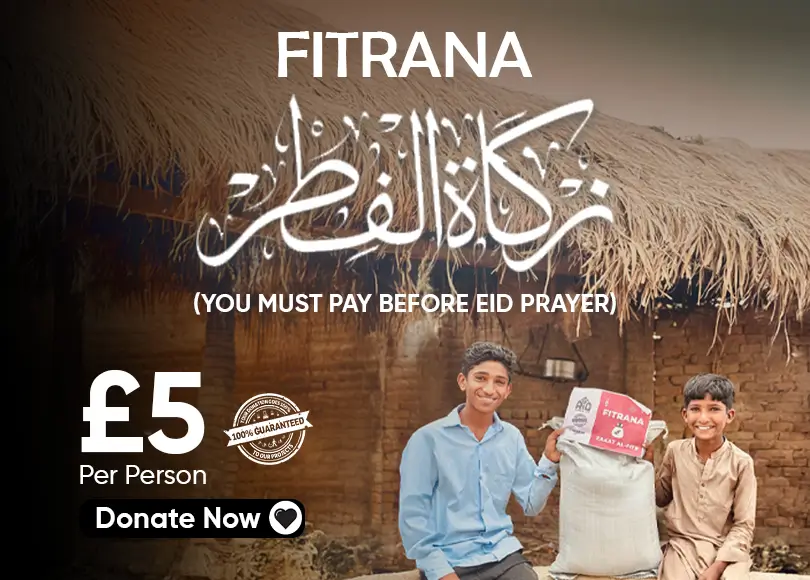
What is
Fitrana and Why Does It Matter?
Fitrana, also known as Zakat al-Fitr, is a compulsory charity given by Muslims at the end of Ramadan, before the Eid prayer. It is not optional — it is an obligation upon every Muslim who has enough to provide for themselves and their dependents.
Fitrana is about more than money. It purifies the fast and ensures that no one is excluded on the day of Eid. For the one who gives it, Fitrana completes Ramadan. For the one who receives it, it may be the difference between hardship and joy.
Fitrana in
Islam and Its Significance
The Prophet ﷺ said:
“The fast remains suspended between Heaven and Earth until the Sadaqat al-Fitr is paid.”
— Bayhaqi
Fitrana cleanses the fast from shortcomings — careless speech, minor mistakes, and missed moments of restraint. It also preserves the dignity of the poor by allowing them to celebrate Eid without hunger or anxiety.
While Fitrana is not named explicitly in the Qur’an, its meaning is rooted in the principle of purification through giving.
Allah says:
“He has certainly succeeded who purifies himself, and remembers the name of his Lord and prays.”
— Surah Al-A‘la (87:14–15)
The obligation of Fitrana is clearly established in the Sunnah:
“The Messenger of Allah ﷺ made Zakat al-Fitr obligatory as a purification for the fasting person from idle talk and foul language, and as food for the poor. Whoever gives it before the Eid prayer, it is accepted as Zakat. Whoever gives it after the prayer, it is only charity.”
— Abu Dawood
When Should
Fitrana Be Paid?
Fitrana must be paid before Eid al-Fitr Salah. The earlier it’s given, the more likely it is to reach the poor in time for them to benefit on Eid day. You can give it any time during Ramadan, but don’t delay it until the last minute. Giving it a few days before Eid allows charities to arrange proper distributions.
Fitrana
Calculator – How Much Should I Give?
The amount of Fitrana is based on the value of staple foods — traditionally a measure of dates, wheat, or rice. For simplicity, most charities set a fixed amount each year based on local food prices. You can use a Fitrana calculator or follow your local masjid’s guidance to give the correct amount.
At Akram Aid, we set the Fitrana rate to reflect the value of feeding one person a simple meal — with 100% of your donation going directly to the poor.
Fitrana
Rules – What You Need to Know
Here are the rules for fitrana:
Fitrana is obligatory on every Muslim who can afford it
It must be given before Eid al-Fitr Salah to count as Zakat al-Fitr
It should be given in food or its value in money, which is then used to feed the poor
It is due for every person in the household, including dependents
It cannot be given after Eid prayer — if delayed, it becomes general charity, not Fitrana

Fitrana
vs Zakat – What’s the Difference?
Though both involve giving, Fitrana and Zakat are not the same.
Zakat
Zakat is one of the five pillars of Islam, due annually on wealth over a set threshold
Fitrana
A fixed charity paid before Eid, on behalf of every Muslim under your care
Zakat purifies wealth. Fitrana purifies the fast.
Give With
Intention. Give With Care.
Fitrana is not a transaction — it’s a trust.
It’s a quiet reminder that your fast was accepted, your heart softened, and your hand opened. It allows someone else to eat, dress, and smile on the day of Eid, just like you. At Akram Aid, we make sure your Fitrana reaches the right hands at the right time — with full dignity and care. As always, we operate with a 100% Donation Policy, ensuring that your charity is delivered in full.
Give Your
Fitrana Early – Support More Than Just a Meal
When you give Fitrana early in Ramadan, it gives us time to reach those who need it most — not just with a one-off meal, but with deeper support.
Your Fitrana helps us:
Deliver Food Packs to the Needy
Support Our Water Appeal to Give Clean Water to the Poor
Support Widows through the Ramadan Zakat Appeal
Feed the Fasting through the Ramadan Food Appeal
By giving early, your Fitrana becomes part of a wider chain of mercy — helping families eat with dignity, prepare for Eid, and feel the unity of the Ummah. And once Eid has passed, you can continue supporting these vital causes as ongoing Sadaqah. May Allah accept your charity and your fasts. Ameen.
Fitrana
FAQs
1. What is Fitrana?
Fitrana (Zakat al-Fitr) is a compulsory charity given by Muslims at the end of Ramadan. It purifies the fast and ensures the poor can enjoy Eid.
2. Who has to pay Fitrana?
Every Muslim who can afford it must pay Fitrana for themselves and their dependents, including children and even newborns if they’re alive before Eid.
3. When should I give Fitrana?
Fitrana should be given before the Eid salah. It can be paid anytime during Ramadan, but giving early ensures it reaches the poor in time.
4. How is Fitrana different from Zakat?
Zakat is paid yearly on savings and wealth. Fitrana is a small, fixed charity due at the end of Ramadan for every person, regardless of wealth.
5. Can I give Fitrana in money?
Yes. While originally given in food, most scholars agree it’s acceptable to give its value in money, so it can be used to buy food for the needy.
6. How much is Fitrana per person?
The amount is based on the cost of staple food (e.g., wheat or dates). Check your local masjid or use a Fitrana calculator for the current rate.
7. Can I give Fitrana after Eid?
Fitrana must be given before the Eid prayer. If it’s given after, it counts as regular charity, not Zakat al-Fitr.
8. Can I give Fitrana on behalf of my children or family?
Yes. The head of the household is responsible for giving Fitrana on behalf of each dependent, including children and newborns (if born before Eid).
9. Is Fitrana obligatory for children?
Yes, Fitrana is due for every Muslim, including children. A parent or guardian pays it on their behalf.
10. Can I give Fitrana to my relatives?
You can give Fitrana to poor relatives who are eligible to receive Zakat, as long as they are not your direct dependents (e.g., spouse or children).
11. Can I give Fitrana to non-Muslims?
No. Fitrana is specifically intended for poor Muslims so they can enjoy the day of Eid with dignity.
12. Does paying Fitrana cover missed fasts?
No. Fitrana is separate from Fidya. Missed fasts due to long-term illness require Fidya, not Fitrana.
13. Can I give Fitrana through a charity?
Yes. Most people give Fitrana through trusted charities that distribute food or its value to the poor in time for Eid.