
Ramadan Daily Giving
Key Takeaways
- Ramadan Daily Giving makes charity a consistent part of the blessed month.
- Small donations can still contribute towards food, clean water, education and essential support.
- Islam encourages sincere and consistent good deeds, even when they are small.
- Daily Sadaqah and Zakat are different forms of giving and should be treated accordingly.
- Recurring charity can help donors maintain regular giving without creating financial pressure.
- Choosing a transparent and trustworthy charity helps ensure donations are handled responsibly.
- Akram Aid operates a 100% Donation Policy and is volunteer-run, helping donations go directly to the intended cause.
Ramadan Daily Giving: Why Small, Consistent Sadaqah Matters
Ramadan invites us to look differently at what we have.
We feel hunger for part of the day, become more conscious of our blessings and try to draw closer to Allah through fasting, Salah, Qur’an and acts of kindness.
Charity naturally becomes part of that journey.
But meaningful Ramadan charity does not have to begin with a large donation. Ramadan Daily Giving is simply the practice of making charity part of your routine throughout the blessed month.
It might be a small amount given each day, or a recurring donation arranged in advance. Either way, the intention is the same: to make generosity a consistent part of Ramadan.
For someone facing hardship, what feels like a small donation to us can contribute towards food, clean water, education or essential support.
And for the person giving, Daily Sadaqah provides another opportunity to turn an ordinary day of Ramadan into an act done for the sake of Allah.
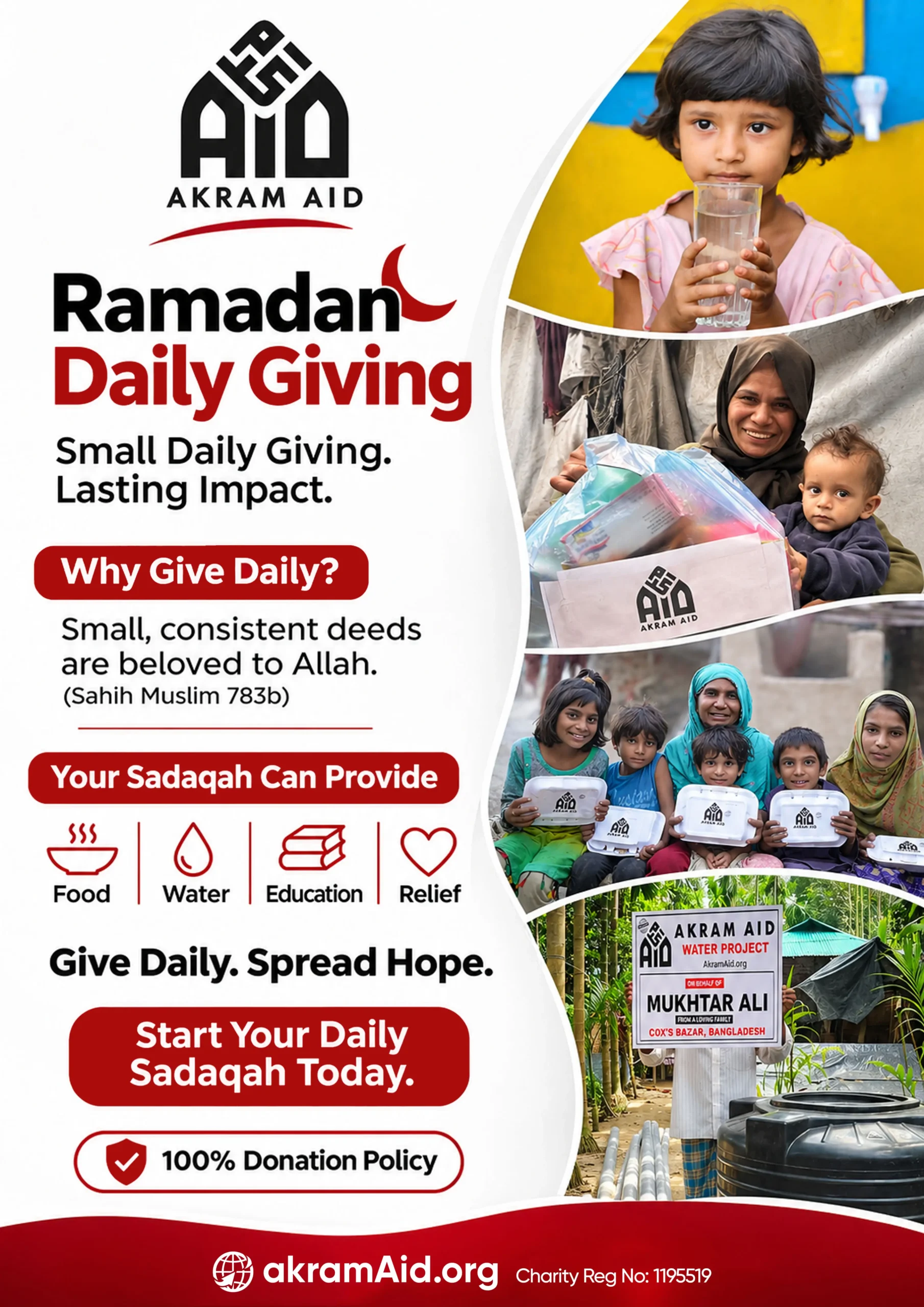
What is Ramadan Daily Giving?
Ramadan Daily Giving means giving Sadaqah regularly throughout Ramadan rather than waiting for one particular day to make a donation.
There is no requirement for the amount to be large.
In fact, Islam teaches us something important about consistency.
The Messenger of Allah ﷺ said:
“The acts most pleasing to Allah are those which are done continuously, even if they are small.”
Sahih Muslim 783b
That principle can change the way we think about small donations.
A person who cannot make a large Ramadan donation should never feel that their contribution has little value. What matters is sincerity, ability and the intention behind the act.
Daily charity gives us a simple way to return to that intention throughout the month.
One day may help towards food.
Another may contribute towards water.
Another may support an orphan, widow or child in education.
Over time, these individual acts become a habit of generosity.
Why is charity so important during Ramadan?
The Prophet Muhammad ﷺ was known for his generosity throughout the year, but his generosity increased during Ramadan.
Ibn ‘Abbas رضي الله عنهما reported that the Prophet ﷺ was the most generous of people and became even more generous during Ramadan when Jibril عليه السلام met him and reviewed the Qur’an with him.
Sahih al-Bukhari 1902
This gives Ramadan Giving a special place in the life of a Muslim.
Fasting teaches restraint. Charity teaches us to look beyond ourselves.
When the two come together, Ramadan becomes not only a month in which we experience temporary hunger, but also a month in which we become more conscious of people for whom hunger, unsafe water or financial hardship are everyday realities.
Giving does not require guilt.
It requires awareness, compassion and action within our means.
What does the Qur’an teach about giving charity?
Allah says:
مَّثَلُ ٱلَّذِينَ يُنفِقُونَ أَمْوَٰلَهُمْ فِى سَبِيلِ ٱللَّهِ كَمَثَلِ حَبَّةٍ أَنۢبَتَتْ سَبْعَ سَنَابِلَ فِى كُلِّ سُنۢبُلَةٍۢ مِّا۟ئَةُ حَبَّةٍۢ ۗ وَٱللَّهُ يُضَـٰعِفُ لِمَن يَشَآءُ ۗ وَٱللَّهُ وَٰسِعٌ عَلِيمٌ
“The example of those who spend their wealth in the way of Allah is like a grain that grows seven ears; in every ear there are a hundred grains. Allah multiplies for whoever He wills. And Allah is All-Bountiful, All-Knowing.”
Surah Al-Baqarah 2:261
This verse is one of the clearest examples of charity in the Quran.
It teaches us not to measure an act of charity only by what leaves our hands.
Allah knows the intention behind it.
He knows what giving required from us.
And He knows the benefit that may come from it.
That is why a sincere contribution should never be dismissed simply because it appears small.
The believer gives according to their means and leaves the reward with Allah.
Why can small, regular donations matter?
Large humanitarian needs can sometimes make an individual donor feel powerless.
When millions of people need support, what difference can one person make?
The answer becomes clearer when we stop thinking only in global numbers and think about individual lives.
A donation does not have to solve poverty everywhere to matter.
It can help one family receive food.
It can contribute towards safer water for one community.
It can support educational opportunities for one child.
Charitable projects are often made possible because many people give what they can. Small donations come together and allow practical work to happen.
This is one of the strengths of Regular Charity. It replaces the idea that generosity must always involve a large one-off contribution with something more sustainable: giving within your means and continuing when you can.
Why does Ramadan charity remain so important today?
Statistics cannot describe the experience of an individual family, and people facing poverty should never be reduced to numbers.
However, reliable figures help us understand the scale of some of the challenges communities continue to face.
- The World Bank reports that around 811 million people are living in extreme poverty in 2026, equivalent to roughly one in ten people worldwide.
- WHO and UNICEF report that 2.1 billion people lacked safely managed drinking water in 2024.
- UNESCO reports that 273 million children and young people were out of school in 2024, with progress in reducing out-of-school rates remaining slow.
Behind every figure is a person with the same need for dignity, security and opportunity that we would want for our own families.
Ramadan gives us an opportunity to respond to those needs in practical ways.
How can Ramadan giving help families experiencing poverty?
For a household already living on very little, the cost of basic food can place enormous pressure on the family budget.
Supporting a charity for poor families can help provide essential provisions to households facing those circumstances.
Food assistance may include staple ingredients, family food packs or prepared meals, depending on the location and project.
A responsible food charity should aim to provide that assistance while protecting the dignity of the people receiving it.
This matters particularly during Ramadan.
As we prepare for Iftar knowing food is waiting for us, other families may be uncertain about what they will have to eat.
Supporting a poverty relief charity cannot solve every cause of poverty, but it can provide meaningful relief at a time when a family needs it.
Sometimes relief begins with something as simple as knowing there will be food in the home.
How can water donations support communities?
Clean water is something many of us rarely have to think about.
We open a tap and expect water to be there.
For millions of people, safe water is far less certain.
Water donations can contribute towards projects that improve access to water in communities where reliable sources are limited.
Depending on local circumstances, this might involve wells, pumps, water storage systems or other appropriate water solutions.
Supporting water for poor communities can have an impact beyond drinking water alone. Better access can help with cooking, washing and everyday hygiene while reducing the time some families spend collecting water.
Where a water project continues benefiting people over time and meets the relevant Islamic conditions, it may also become a means of Sadaqah Jariyah.
The value lies not merely in building something, but in creating a useful resource that continues serving people.
Why support education during Ramadan?
Poverty does not only affect food and shelter.
It can also shape a child’s access to education.
Families facing severe financial difficulty may struggle with school materials, transport, fees or other barriers that make regular attendance difficult.
Supporting an education charity can help address some of those obstacles.
Depending on the project, school donations may contribute towards learning materials, educational facilities or practical assistance that enables children to continue learning.
Supporting education for poor children can have benefits far beyond the immediate school year.
Education can improve literacy, confidence and future opportunities. Well-planned education projects therefore complement immediate forms of humanitarian support such as food and water.
One responds to an urgent need.
The other can help a child build towards a different future.
Both matter.
Is Daily Sadaqah the same as Zakat?
No.
Sadaqah is voluntary charity. It can be given at any time and, depending on the cause, can support many different forms of charitable work.
Zakat is an obligatory act of worship for Muslims who meet the relevant conditions. It has specific rules regarding calculation, eligible recipients and distribution.
For this reason, Zakat Donations should be clearly identified and distributed according to Islamic requirements.
Daily Sadaqah during Ramadan does not replace Zakat.
A Muslim may give both during the month: fulfilling their Zakat obligation where applicable while also choosing to give voluntary Sadaqah.
Understanding the distinction helps ensure each form of giving is treated correctly.
Is recurring charity a good way to give during Ramadan?
For many people, yes.
Ramadan can be busy.
Between work, family responsibilities, preparing meals, Salah, Taraweeh and Qur’an, it is easy to reach the end of the day and realise something we intended to do has been forgotten.
A Recurring Charity arrangement can make Daily Sadaqah easier to maintain.
Rather than remembering to make an individual donation every day, someone can arrange their giving in advance.
The technology is simply a tool.
The intention remains with the donor.
For some people, a habit developed during Ramadan may even continue afterwards through Monthly Charity or another form of Regular Charity.
There is no need to make the amount difficult to sustain.
The aim should be consistency within your means, not financial pressure.
What should you look for when giving to an online charity?
Online giving has made it possible to support humanitarian work in communities far beyond our own neighbourhoods.
But convenience should still be accompanied by care.
Before donating to an Online Charity, it is worth understanding:
- where your donation is intended to go
- what type of project it will support
- how the charity explains its donation policy
- whether information about its work is clear and transparent
- how it approaches accountability
Trust matters because charity is an Amanah.
At Akram Aid, we operate a 100% Donation Policy, meaning 100% of donations given to our charitable causes go to the cause.
Our work is volunteer-run, helping us maintain that commitment.
For us, accountability is not simply about reporting to donors. We believe we are accountable before Allah for what is entrusted to us.
That responsibility should shape how every donation is treated, whether it is large or small.
Ramadan Daily Giving is ultimately about intention
There is no single amount that defines meaningful charity.
For one person, giving a small amount may be easy.
For another, the same amount may represent a real sacrifice.
Allah knows the difference.
That is why Ramadan Daily Giving should never become a competition or a source of pressure.
Give according to your circumstances.
Give sincerely.
Give where you believe it can bring genuine benefit.
And when possible, make generosity something you return to regularly.
Your Daily Sadaqah may become part of a family’s food, a community’s access to water, a child’s education or assistance for someone going through a difficult period.
You may never meet the person who benefits.
They may never know your name.
But Allah knows what was given and why it was given.
May Allah accept our fasting, Salah, charity and every sincere deed performed during Ramadan. May He place barakah in what we give, bring relief to families facing hardship and allow our charity to become a source of benefit in this life and reward in the Hereafter. Ameen.
Make Daily Sadaqah part of your Ramadan and give for the sake of Allah through Akram Aid’s 100% Donation Policy.
Frequently Asked Questions about Ramadan Daily Giving
What Is Daily Giving?
Daily Giving means making a small charitable donation each day or arranging regular donations to support people in need.
Why Is Giving Charity Every Day Important?
Giving regularly helps make generosity a consistent habit and allows ongoing support for charitable causes.
How Can I Make Charity a Daily Habit?
Set aside an affordable amount each day or arrange a recurring donation so your giving remains consistent.
Can Small Daily Donations Make a Difference?
Yes. Small donations can combine with the generosity of others to help provide food, water, education and essential support.
Why Is Daily Giving So Important During Ramadan?
Ramadan is a month of worship and generosity. Daily Giving helps Muslims make charity a regular part of the blessed month.
Why Should Muslims Give Charity Every Day During Ramadan?
Regular charity allows Muslims to increase their good deeds throughout Ramadan while helping people facing hardship.
What Are the Benefits of Daily Charity During Ramadan?
Daily charity encourages consistency, strengthens generosity and provides repeated opportunities to support people in need for the sake of Allah.
What Is Sadaqah in Islam?
Sadaqah is voluntary charity given sincerely for the sake of Allah. It can include money, practical help and other acts of kindness.
Why Is Sadaqah Important in Islam?
Sadaqah encourages compassion, generosity and care for others while helping Muslims use their wealth for good.
What Are the Rewards of Giving Sadaqah?
Allah promises reward for sincere charity, and even a small act given for His sake can carry great value.
What Is Zakat and Why Is It Important?
Zakat is an obligatory form of charity for eligible Muslims. It purifies wealth and supports people who qualify to receive it.
Who Is Eligible to Receive Zakat?
The Qur’an identifies specific categories of people who may receive Zakat, including the poor and needy. Zakat must be distributed according to Islamic guidelines.
When Should Muslims Pay Zakat?
Zakat becomes due when eligible wealth reaches the Nisab threshold and has been held for one lunar year, although some Muslims choose Ramadan as their annual payment time.
Why Is Charity More Rewarding During Ramadan?
Ramadan is a blessed month in which Muslims are encouraged to increase worship, generosity and good deeds.
What Are the Rewards of Giving Charity During Ramadan?
Charity during Ramadan is an opportunity to seek Allah’s reward while providing meaningful help to people facing hardship.
How Can I Increase My Good Deeds During Ramadan?
You can increase your good deeds through Salah, Qur’an, Dhikr, charity, helping others and maintaining sincere intentions.
Why Is Charity Important in Today’s World?
Charity helps provide practical support to people affected by poverty, hunger, unsafe water, displacement and other hardships.
How Can I Donate to Charity Online?
Choose a trusted charity, select the appeal or cause you wish to support and make your donation securely through its official website.
What Are the Best Ways to Help People in Need?
You can give Sadaqah or Zakat, support food and water projects, fund education, volunteer or contribute to humanitarian relief.
What Is Humanitarian Aid?
Humanitarian aid is assistance provided to people affected by emergencies, poverty, conflict or disasters to help meet essential needs.
Why Is Humanitarian Assistance Important?
Humanitarian assistance helps vulnerable people access essentials such as food, clean water, shelter, healthcare and emergency support.
How Can I Help Families Living in Poverty?
You can support trusted charities providing food, clean water, education, emergency relief and longer-term assistance to vulnerable families.
What Is Akram Aid?
Akram Aid is a volunteer-run UK charity supporting vulnerable communities through food, water, education, medical assistance and humanitarian relief.
Is Akram Aid a Registered UK Charity?
Yes. Akram Aid is a registered charity in England and Wales, charity number 1195519.
How Can I Donate to Akram Aid?
You can donate securely through the official Akram Aid website and choose the appeal or charitable cause you wish to support.